NASA Logo Jet Propulsion Laboratory California Institute of Technology View the NASA Portal
NASA Banner
NASA Banner
NASA Banner
JPL HOME EARTH SOLAR SYSTEM STARS & GALAXIES SCIENCE & TECHNOLOGY
NASA Banner
JPL Science
JPL Science Division Home
Planetary Science Planetary Science
Astrophysics & Space Science Astrophysics & Space Science
Climate, Oceans and Solid Earth Science Climate, Oceans and Solid Earth Science
Solid Earth
AIRS Atmospheric Science
People
Projects
Water and Carbon Cycles
Ocean Circulation
Ocean-Atmosphere Interaction
Orbiting Carbon Observatory Science
Earth Surface Science Group
Earth Atmospheric Science Earth Atmospheric Science
Table Mountain Facility Table Mountain Facility
Open Postdoc Positions Open Postdoc Positions
 AIRS Atmospheric Science: People
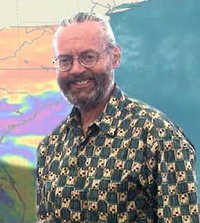
Bjorn Lambrigtsen's Picture
Address:
Jet Propulsion Laboratory
M/S 169-237
4800 Oak Grove Drive
Pasadena, CA 91109
Phone:
818.354.8932
Fax:
818.393.4619
Email:

Bjorn Lambrigtsen
Group Supervisor
Section Deputy Manager (Acting)

Bjorn Lambrigtsen is a scientist who specializes in microwave observations of the Earth's atmosphere. His research activities ranges from the development of new technology and observational systems to the study of hurricanes. Since 1991 he has been the Microwave Instrument Scientist for the Atmospheric Infrared Sounder carried on NASA's Aqua satellite. He is also a member of the science team for NASA's upcoming NPOESS Preparatory Project satellite mission - a pathfinder for the nation's next generation of weather satellites. He led the development of a new aircraft-based microwave sounder, HAMSR, which is used in NASA field campaigns to study hurricanes. Finally, he is leading the development of GeoSTAR, a new concept for a microwave sounder for geostationary satellites.


Education
  • Ph.D.-level graduate work: Physics/J. Marburger, University of Southern California (1969-1978)
  • BS/MS-equivalent: Physics/I. Svare, Norwegian Institute of Technology (1967)

Research Interests
  • Microwave sounding: retrieval methods, new instruments/concepts
  • Hurricane research and data analysis
  • Science algorithm development

Available Postdoc Position

Postdoctoral Positions in Atmospheric Research

Hurricane research: This work is focused on observations from microwave atmospheric sounders deployed on aircraft and satellites. Study topics range from developing new methodologies and algorithms to infer information about both the thermodynamic structure and the microphysics of tropical convection to using these tools to gain understanding of cyclogenesis and hurricane intensification and weakening. Much of this work revolves around hurricane field campaigns and analysis of the data obtained there. The algorithm work is focused on developing new techniques to infer reflectivity and derive precipitation estimates and microphysical parameters from sounder observations. This will enable wide-ranging studies of tropical cyclones using observations from a large number of current and future satellite sounders. The successful candidate will be familiar with current research in tropical convection and will have experience in analyzing large data sets.

Satellite mission development: This work is focused on preparing for the “PATH” mission, one of the NASA “decadal survey” missions. PATH will place an AMSU-equivalent microwave sounder in geostationary orbit and is focused on hurricane and hydrologic-cycle applications, both in a weather and a climate context. The PATH mission is made possible with GeoSTAR, a breakthrough synthetic-aperture radiometer being developed at JPL. This work revolves around simulation studies to determine the expected impact of the PATH observations and developing science methodologies, algorithms and applications. A particular area of interest is to determine the most effective use of such observations in weather and climate models and investigate how coarse-resolution observations are most effectively used with high-resolution models. The successful candidate will be familiar with modeling, simulations, methods used in Operational System Simulation Experiments (OSSE), and current research in fields relevant to PATH.

Microwave sounding science: This work is focused on the use of microwave sounding observations in general atmospheric and climate research. Past, current and future sensors will be studied. Particular areas of interest is the development of climatologies from microwave sounders, and the study of cloudy weather and climate regimes that are poorly sampled with other sensors, such as infrared sounders. With the availability of satellite and aircraft data and model simulations, spatial scale issues can be studied in relation to probability distribution functions of thermodynamic variables and cloud parameters. In addition to general atmospheric research, this work is applicable to the development of future satellite missions, including the upcoming NPP mission being developed by NASA in collaboration with other agencies. A key question is whether the data obtained from NPP weather sensors, which includes a microwave sounder, can be used to support climate research. This work is intended to address that question. The successful candidate will be familiar with current research in atmospheric science and should be familiar with the use of data from microwave or infrared sounders. Knowledge of satellite systems and sensors is a plus.


Projects

AIRS Icon AIRS
The Atmospheric Infrared Sounder, AIRS, is an instrument whose goal is to support climate research and improved weather forecasting.

GeoSTAR Icon GeoSTAR
The Geostationary Synthetic Thinned Aperture Radiometer (GeoSTAR) is a new concept for a microwave sounder, intended to be deployed on NOAA's next generation of geostationary weather satellites, the GOES-R series.

NPP Icon NPP
The National Polar-Orbiting Operational Environmental Satellite System (NPOESS) Preparatory Project (NPP) mission collects and distributes remotely-sensed land, ocean, and atmospheric data to the meteorological and global climate change communities.

NAMMA Icon NAMMA
The NASA African Monsoon Multidisciplinary Analyses (NAMMA) campaign is a field research investigation sponsored by the Science Mission Directorate of the National Aeronautics and Space Administration (NASA).

TCSP Icon TCSP
The Tropical Cloud Systems and Processes (TCSP) mission is an Earth science field research investigation sponsored by the Science Mission Directorate of the National Aeronautics and Space Administration (NASA).


Professional Experience
  • Jet Propulsion Laboratory (1982-present)
    • Lead Scientist/ Group Supervisor (2002-present)
    • AIRS Microwave Instrument Scientist (1991-present)
    • Principal Investigator, GEO/SAMS and GeoSTAR (1999-present)
    • Principal Investigator, HAMSR (1998-present)
    • Member of NPP Science Team (2003-present)
    • AIRS Direct Broadcast Representative (1998-2002)
    • Acting Instrument Scientist for IMAS (1997-2000)
    • TOPEX Algorithm Development (1990-1992)
    • NSCAT Algorithm Development (1987-1990)
    • Microwave Research & Algorithm Development (1982-1987)

Selected Awards
NASA Exceptional Achievement Medal (2004)

Selected Publications
  1. Kakar, R.K., B.H. Lambrigtsen: "A Statistical Correlation Method for the Retrieval of Atmospheric Moisture Profiles by Microwave Radiometry;" J. Climate Appl. Meteor., 23, 1110-1114 (1984)
  2. Kakar, R.K., B.H. Lambrigtsen: "Retrieval of Vertical Moisture Profiles with Microwave Radiometry;" Proc. IGARSS '84, 449-451 (1984)
  3. Lambrigtsen, B.H., R.K. Kakar: "Estimation of Atmospheric Moisture Content from Microwave Radiometric Measurements during CCOPE;" J. Climate Appl. Meteor., 24, 266-274 (1985)
  4. Watkins, S.S., P.M. Chau, R. Tawel, B.H. Lambrigtsen, M. Plutowski: "A Hybrid Radial Basis Function Neurocomputer and its Applications;" Advances in Neural Information Processing Systems 6 (NIPS 6), 850-857 (1994)
  5. Watkins, S.S., P.M. Chau, R. Tawel, B.H. Lambrigtsen: "Execution of a Remote Sensing Application on a Custom Neurocomputer;" IEEE Trans. Neural Networks, 6, 1505-1515 (1995)
  6. Lambrigtsen, B.H.: HAMSR - The first of a new generation of microwave sounders;" 10th International TOVS Study Conference, Boulder, CO, Report, p. 59 (1999)
  7. Lambrigtsen, B.H.: "GEO/SAMS - The Geostationary Synthetic Aperture Microwave Sounder;" Proc. IGARSS (2000)
  8. Lambrigtsen, B.H., A.L. Riley: "HAMSR - The High Altitude MMIC Sounding Radiometer;" Proc. NASA Earth Science Technology Conference (2001)
  9. Lambrigtsen, B.H., A.L. Riley: "Microwave Scattering Observed in Convective Cells During CAMEX-4;" Proc. AMS 25th Conference on Hurricanes and Tropical Meteorology, p. 515 (2002)
  10. Lambrigtsen, B.H., E.F. Fishbein, A.L. Riley: "Hurricane Research with the High Altitude MMIC Sounding Radiometer;" Proc. NASA Earth Science Technology Conference (2002)
  11. Lambrigtsen, B.H.: "Calibration of the AIRS Microwave Instruments;" IEEE Trans. Geosci. Remote Sensing, vol. 41, pp. 369-378 (2003)
  12. Lambrigtsen, B.H., S.-Y. Lee: "Co-Alignment and Synchronization of the AIRS Instrument Suite;" IEEE Trans. Geosci. Remote Sensing, vol. 41, pp. 343-351 (2003)
  13. Lambrigtsen, B.H., R.V. Calheiros: "The Humidity Sounder for Brazil - An International Partnership;" IEEE Trans. Geosci. Remote Sensing, vol. 41, pp. 352- 361 (2003)
  14. Lambrigtsen, B.H.: "GeoSTAR - A New Approach for a Geostationary Microwave Sounder;" 13th International TOVS Study Conference, Ste.-Adele, Canada (2003)
  15. Lambrigtsen, B.H.: "Flooding Estimates from Aqua Microwave Observations;" Fall AGU, San Francisco (2003)
  16. Lambrigtsen, B.H., W. Wilson, A. Tanner, T. Gaier: "GeoSTAR - A Synthetic Aperture Approach for a Geostationary Microwave Sounder;" IEEE Aerospace Conference, Big Sky, MT (2004)
  17. Lambrigtsen, B.H, S. Brown, S. Dinardo, P. Kangaslahti, W. Wilson: "Progress in developing GeoSTAR - A microwave sounder for GOES-R", Proc. SPIE, Vol. 5882, doi:10.1117/12.615269 (2005)
  18. Lambrigtsen, B.H., A. Tanner, T. Gaier, P. Kangaslahti, S. Brown: "A Microwave Sounder for GOES-R: Developing the GeoSTAR Mission", Proc. IGARSS'06 (2006)

Group Home Page
People in this Group
Group Projects

JPL Privacy Statement Sitemap Email Contact Form
FIRST GOV NASA Home Page